Saturday, May 1, 2010

Bruges, West Flanders, Belgium *****


Bruges is the capital and largest city of the province of West Flanders in the Flemish Region of Belgium. It is located in the northwest of the country.  The historic city centre is a prominent World Heritage Site of UNESCO. It is egg-shaped and about 430 hectares in size. The area of the whole city amounts to more than 13,840 hectares, including 1,075 hectares off the coast, at Zeebrugge (meaning "Brugge aan Zee[1] or "Bruges on Sea"[2]). The city's total population is 117,073 (1 January 2008),[3] of which around 20,000 live in the historic centre. The metropolitan area, including the outer commuter zone, covers an area of 616 km² and has a total of 255,844 inhabitants as of 1 January 2008.  Along with a few other canal-based northern cities, such as Amsterdam, it is sometimes referred to as "The Venice of the North".  Bruges has a significant economic importance thanks to its port. At one time it was the "chief commercial city" of the world.


Bruges has most of its medieval architecture intact. The historic centre of Bruges has been aUNESCO World Heritage Site since 2000.  Many of its medieval buildings are notable, including the Church of Our Lady, whose brick spire reaches 122.3 m (401.25 ft), making it one of the world's highest brick towers/buildings. The sculpture Madonna and Child, which can be seen in the transept, is believed to be Michelangelo's only sculpture to have left Italy within his lifetime. 


 Bruges has most of its medieval architecture intact. The historic centre of Bruges has been a UNESCO World Heritage Site since 2000.  Many of its medieval buildings are notable, including the Church of Our Lady, whose brick spire reaches 122.3 m (401.25 ft), making it one of the world's highest brick towers/buildings. The sculpture Madonna and Child, which can be seen in the transept, is believed to be Michelangelo's only sculpture to have left Italy within his lifetime.  Bruges' most famous landmark is its 13th-century belfry, housing a municipal carillon comprising 48 bells. The city still employs a full-time carillonneur, who gives free concerts on a regular basis.  Other famous buildings in Bruges include:
  • The Beguinage
  • The Basilica of the Holy Blood (Dutch: Heilig-Bloedbasiliek). The relic of the Holy Blood, which was brought to the city after the Second Crusade by Thierry of Alsace, is paraded every year through the streets of the city. More than 1,600 inhabitants take part in this mile-long religious procession, many dressed as medieval knights or crusaders.
  • The modern Concertgebouw ("Concert Building")
  • The Old St-John's Hospital
  • The Saint Salvator's Cathedral
  • The Groeningemuseum
  • The City Hall on the Burg square
  • The Provincial Court (Provinciaal Hof)
  • The preserved old city gateways: the Kruispoort, the Gentpoort, the Smedenpoort and the Ezelpoort. The Dampoort, the Katelijnepoort and the Boeveriepoort are gone.
Bruges also has a very fine collection of medieval and early modern art, including the world-famous collection of Flemish Primitives. Various masters, such as Hans Memling and Jan van Eyck, lived and worked in Bruges.


Source: Wikipedia

Rick Steves' Amsterdam, Bruges, and BrusselsHistoric Walking Guides BrugesRick Steves' Snapshot Bruges & Brussels (Rick Steves Snapshot)Brussels, Bruges, Antwerp and Ghent (DK Eyewitness Top 10 Travel Guide)

Friday, April 30, 2010

Alain Robert

PhotoCredit:travelhouseuk

Alain Robert (born as Robert Alain Philippe on 7 August 1962), is a French rock and urban climber, from Digoin, Saône-et-Loire, Bourgogne, France. Known as "the French Spider-Man" (after the Marvel Comics character Spider-Man), or "the Human Spider", Robert is famous for scaling skyscrapers.  Robert has scaled 85 giant structures around the globe including many of the world's tallest structures, most of which he has scaled using only his bare hands and climbing shoes.  

Robert began climbing as a young boy, scaling rock cliffs in the area around his home. His buildering career began at the age of 12 when he forgot his keys and was locked out of his parents' eighth-floor apartment. Instead of waiting for them to return home, he simply scaled the exterior wall to his home.  In 1982 he suffered two accidents, the first in January at the age of 19 and the second in September at the age of 20. He fell 15 metres (49 ft) on each occasion. He suffered multiple fractures and now suffers from permanent vertigo.  The doctors considered him 60 percent handicapped and told him he would not be able to climb again. However, within 6 months he was climbing again. He kept taking on more and more challenging structures and improving his skills. He polished his rock-climbing skills in the French Alps before turning to buildings.
Source: Wikipedia


Thursday, April 29, 2010

Greek Islands in Top 10 Summer Destinations

You are going to have many options when planning vacationsin Greece. There are many choices to make, but perhaps the mostdifficult revolves around when to go. Are you aiming to travel Greecewhen Greece tourism is slow, or are you looking for the summer partieson the islands? The good thing about Greece travel destinations is thatmany of them are historic sites. The ruins that are thousands of yearsold will still be there whether it is February or August. Suffice it tosay that there is no bad time to go to Greece, as vacations in Greeceare rewarding regardless of the season. 

You may think that to travel Greece during the winter months means that the islands are closed completely and that there isn’t much to do around the mainland other than visit the ruins. It can get pretty cold and wet during the months of November, December and January, but often in Athens and in the islands you can catch some warmer, sunny days. The islands,and Greece tourism can experience delays or cancellations due to rough seas. The number off lights or ferries heading to the islands significantly decreases, but you can still visit the islands if you are determined. While many of the larger resorts and tourist restaurants close for the off-season on the islands, but there are smaller hotels and restaurants still open.And, many of the restaurants that are open are popular with the locals,meaning the food is likely to be better.


Islands like Mykonos, Crete, Rhodes and Santorini attract visitors year round, and many who rent their houses out in the summer return afterwards and claim the off-season is their favorite time.You simply get all the views to yourself, and a beach can be rewarding in the winter if you don’t mind the fact that the water can be cold.Prices during the off-season, specifically in the winter, are way down and it is a good time to snatch up those cheap flights to Greece.If you are a skier, you will love Greece in the winter.The mountains on the Peleponnese peninsula and in northern Greece get their fair share of snow, and the skiing can be pretty good.Many just don’t know about it.Of particular interest in the winter are the performances at both the Athens Concert Hall and the Thessaloniki weather is fairly temperate, although it can get pretty cold at times, and winter shopping bargains are easily found.  

As with the winter months, the fall and spring months can be veryrewarding in Greece. These are great months to plan vacations in Greeceif you are looking to enjoy the outdoors. Walks or hikes through theGreek countryside in spring can be particularly rewarding. Spring flowers are blooming all over the countryside and birdwatching is atit’s best. Eco-tours are great Greek tours to enjoy outside of thesummer months. 


If you are looking for an “outside the box” idea forGreece travel destinations, try heading to the Greek mountains in thespring and fall and take a jeep tour to some of the areas most don’tknow about. You can find a lot of great weather if you travel Greece inthe spring and fall, and you will also find great hotel rates. May andSeptember just might be the best months to plan vacations in Greece.The weather is great and prices are still pretty low. 

Alas, we come to the summer, when Greece tourism is at its peak. Itcan get pretty hot in Greece during especially the months of July andAugust. These two months are the busiest in the islands, and while theferries and flights to the islands can get pretty crowded, this is thebest season to find the most number of them. Greek festivals and events can be found throughout Greece in the summer.The Hellenic Festival is in full swing in Athens, and performances at the Odeon of Herodes Atticustheatre and on Lykavittos Hill are popular draws for both Greeks andtourists. In July, wine enthusiasts can enjoy the wine festivals onCrete. Greece travel destinations most popular in the summer are, ofcourse, the beaches. The beaches in Greece are wonderful, offering something for everyone, and island beaches like Paradise Beach have nightlife that goes well into the wee hours.

There really just isn’t a bad time to travel Greece. The ruinsspread throughout the country will be there any time of year, and whenit comes to weather, well you just take advantage of whatever you get.When planning vacations in Greece, it can be as simple as decidingwhether suntanning and swimming in the Aegean Sea is your main focus,then go from there.
Source: destination360.com

Wednesday, April 28, 2010

Luxembourg City **

The Grand Duchy of Luxembourg is a small country surrounded by Belgium, France and Germany, and its history has been inextricably linked with that of its larger neighbours. It is largely made up of rolling hills and forests.

Luxembourg has been under the control of many states and ruling houses in its long history, but it has been a separate, if not always autonomous, political unit since the 10th century. Today, Luxembourg is a hereditary Grand Duchy with a unicameral parliamentary system. 

Luxembourgish, the national language, is akin to German. German is the first foreign language for most Luxembourgers and is used in the media. French is the administrative language.  The economic structure of Luxembourg is based mainly in banking, insurance, and the steel industry. Agriculture and wine production are also important.

Many of Luxembourg's speciality dishes are of the type one would expect in a forested country. They include jugged hare and Ardennes ham. Trout and pike, fresh from the country’s rivers, also feature regularly on menus here.  Luxembourg shares the Moselle valley with Germany and the local white wines are well known and popular. Like other northern European countries, Luxembourg also produces popular brands of beer.
Source:europa.eu

Tuesday, April 27, 2010

Gewurztraminer ****

Gewurztraminer is the most typical Alsatian wine. Gewûrz means "spicy" in german. It is the main characteristic of Gewurztraminer. Traminer means "coming from Tramin", a small city in south Tyrol of Austria where the grape is coming from. Gewurztraminer is the name of a grape but also the name of the wine made from the grape!

Gewurztraminer was first grown in Alsace around the 19th century. The grapes now cover roughly 20% of the vineyards in the region. Gewurztraminer replaced a grape called Klevener or Savagnin. Nowadays klevener wines can only be found in the village of Heiligenstein and around. Klevener is a dry white wine with slight spicy flavor while less aromatic than Gewurz, it sould be drunk young.

It is obviously in Alsace where Gewurztraminer grapes give the best results. The wine is delicious, fruity and with strong aromas, a very perfumed and flowery bouquet. Gewurztraminer is sweeter than Riesling, which is a dry wine.

Thick and rich wine, which can age, Gewurztraminer is better with sauerkraut, sausages and the Alsatian cheese Munster, curry seasoned dishes, chinese and mexican cooking and other spiced dishes. A Gewurztraminer can even be served as a dessert wine.

Gewurztraminer is better when served at 10°C (50°F). Gewurztraminer can last up to 10 years in their best years. 
Source:terroir-france

Monday, April 26, 2010

Leberkase (Leberkäse) ***


Leberkäse is a traditional German food made from mixed ground meats baked into a loaf. Essentially, Leberkäse is the German version of meatloaf, featuring traditionally German ingredients, including liver and pork. Some German restaurants offer this delicacy on their menus, as do German butchers, and it can also be made at home and ordered from specialty companies that supply various European food treats.

In German, “Leberkäse” literally means “liver cheese.” One could suppose that the name is a reference to the fact that Leberkäse contains liver and that it can be used sort of like a cheese, but more likely, the term comes from a Middle High German word meaning “loaf.” You can also see Leberkäse spelled as Leberkase or Leberkass.

Austria and Switzerland also serve Leberkäse, reflecting the cultural exchange in this region of Europe, and some regions have their own special Leberkäse recipe, turning it into a local delicacy. In Bavaria, for example, Leberkäse contains no liver at all, only corned beef and bacon, while other producers include veal liver, other pork products, veal itself, and a variety of other meats. Onions are typically included in Leberkäse as well.

To make Leberkäse, cooks grind the meats they are using together with the onions to create a uniform blend, and then pack the ingredients into a loaf pan for baking. The Leberkäse is baked until it develops a crispy crust, with the outside remaining tender and pink. Leberkäse can be served hot, or eaten cold in a variety of ways. Leberkäse sandwiches with mustard, for example, are very popular in Berlin, and some people also like to pan-fry this food as a snack.

Culinary historians believe that Leberkäse dates to the mid-1700s, although it is hard to pin down precise information about its origins. Like other meatloaves, Leberkäse was undoubtedly developed as a way to use up scrap meats efficiently. Making Leberkäse would also be less expensive than using high-quality cuts of meat for roasts, making meat accessible to people in the lower classes who could not afford it otherwise. The dish may also be related to sausages, dishes made from ground meats packed into casings.

In regions where Leberkäse includes liver, the dish may not be to everyone's taste. Liver has a very distinctive flavor which some people find too intense. For people who want to explore Leberkäse without encountering liver, Bavarian-style Leberkäse is highly recommended, as it usually does not contain liver.
Source:wiseGeek

Sunday, April 25, 2010

Discover Carcasonne *****


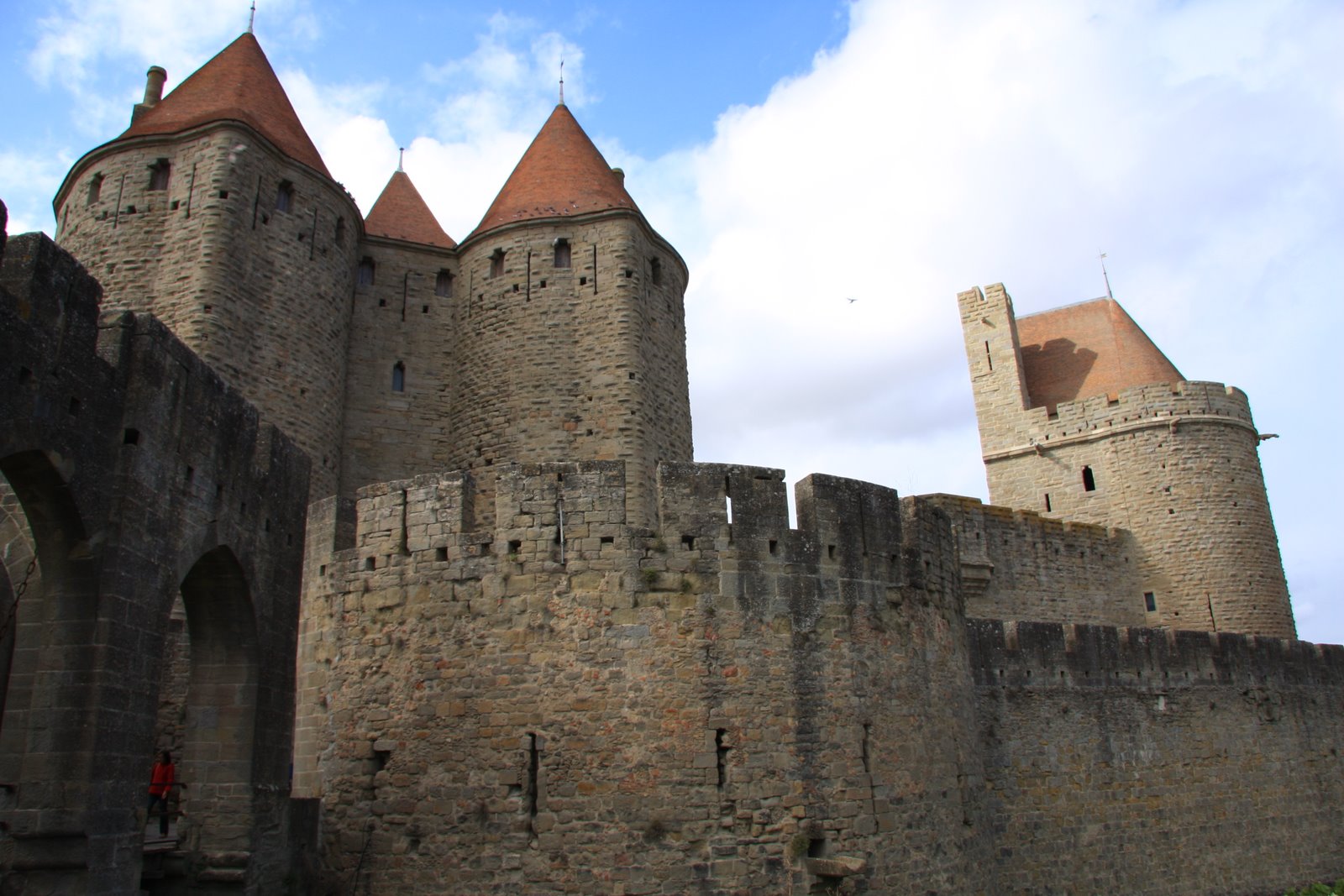
Carcassonne, designated a UNESCO World Heritage Site, is a beautifully restored fortified town, particularly famous as a Cathar stronghold during the Albigensian Crusades.

Visitors here cannot fail to be fascinated by the area's history. In the early 13th century the Catholic Pope launched a crusade against the Cathars. Languedoc was targeted as a Cathar stronghold and local people sought sanctuary in the impregnable hilltop fortresses where they endured many months of siege before succumbing. Many of the "heretics" were killed or burnt at the stake and the surrounding region was devastated. The proud ruins of many of these legendary fortresses, such as Quéribus and Peyrepertuse can be seen to this day, offering visitors an intriguing glimpse back in time as well as striking panoramic views of the surrounding countryside.

Carcasonne was lovingly restored in 1853 and today would not look out of place in a fairytale with its drawbridges and pointed towers. The town is actually divided into 2; the walled, medieval heart of the "Cité" and the commercial "Ville Basse" below. Most visitors head straight for the Cité and their first impressions are the splendid double ramparts surrounding the town, interspersed by 53 towers. Within the walls is the Château Comtal, built in the 12th century as home to the Trencavels, vicomtes of Carcassonne. Today there are guided tours and educational activities as well as a permanent exhibition about the restoration of the Cité.
Nearby, in the Place de l'église, is the Basilica of St-Nazaire. Described as "the jewel of the Cité" the cathedral was founded in the 11th century. Originally built in a Romanesque style, the gargoyles and more recent alterations give the building a more Gothic appearance.

A "petit train" regularly departs from the Porte Narbonnaise to give visitors a tour of the turrets and ramparts. And nearby, just outside the city walls is the Museum of the Middle Ages where visitors can enjoy a scale model of the city as well as interactive exhibits.
Source:ezinearticles