Showing posts with label *****. Show all posts

Tuesday, May 4, 2010

Lindt & Sprüngli *****

Lindt & Sprüngli is the world’s leading manufacturer of premium chocolate, generating more than one billion dollars annually in worldwide sales. Based in Switzerland with sixteen worldwide subsidiaries, the Lindt & Sprüngli trademark has been a symbol of quality, using only first-grade materials, distinguished by purity and unequalled flavor. We spare no effort to continue earning the confidence of chocolate connoisseurs all over the world. 

The word “quality” has a special significance and a special tradition in the company. In 1879 Rodolphne Lindt set a standard with hi “Chocolat fondant Rod. Lindt fils,” which was unique in its time. It became a standard by which all successive generations of chocolate manufacturers worldwide strive to meet. In 1899, the Lindt brand name, the manufacturing process, and the obligation to maintain supreme quality, became the company: Lindt & Sprüngli AG. The preoccupation with quality has been emphasized by the fact that there has been a master confectioner in each of the five generations of the family, an expert who by professional training knows the Lindt product inside and out. Quality is the basis for, and the key to Lindt & Sprüngli’s success.  
Source: monster

Saturday, May 1, 2010

Bruges, West Flanders, Belgium *****


Bruges is the capital and largest city of the province of West Flanders in the Flemish Region of Belgium. It is located in the northwest of the country.  The historic city centre is a prominent World Heritage Site of UNESCO. It is egg-shaped and about 430 hectares in size. The area of the whole city amounts to more than 13,840 hectares, including 1,075 hectares off the coast, at Zeebrugge (meaning "Brugge aan Zee[1] or "Bruges on Sea"[2]). The city's total population is 117,073 (1 January 2008),[3] of which around 20,000 live in the historic centre. The metropolitan area, including the outer commuter zone, covers an area of 616 km² and has a total of 255,844 inhabitants as of 1 January 2008.  Along with a few other canal-based northern cities, such as Amsterdam, it is sometimes referred to as "The Venice of the North".  Bruges has a significant economic importance thanks to its port. At one time it was the "chief commercial city" of the world.


Bruges has most of its medieval architecture intact. The historic centre of Bruges has been aUNESCO World Heritage Site since 2000.  Many of its medieval buildings are notable, including the Church of Our Lady, whose brick spire reaches 122.3 m (401.25 ft), making it one of the world's highest brick towers/buildings. The sculpture Madonna and Child, which can be seen in the transept, is believed to be Michelangelo's only sculpture to have left Italy within his lifetime. 


 Bruges has most of its medieval architecture intact. The historic centre of Bruges has been a UNESCO World Heritage Site since 2000.  Many of its medieval buildings are notable, including the Church of Our Lady, whose brick spire reaches 122.3 m (401.25 ft), making it one of the world's highest brick towers/buildings. The sculpture Madonna and Child, which can be seen in the transept, is believed to be Michelangelo's only sculpture to have left Italy within his lifetime.  Bruges' most famous landmark is its 13th-century belfry, housing a municipal carillon comprising 48 bells. The city still employs a full-time carillonneur, who gives free concerts on a regular basis.  Other famous buildings in Bruges include:
  • The Beguinage
  • The Basilica of the Holy Blood (Dutch: Heilig-Bloedbasiliek). The relic of the Holy Blood, which was brought to the city after the Second Crusade by Thierry of Alsace, is paraded every year through the streets of the city. More than 1,600 inhabitants take part in this mile-long religious procession, many dressed as medieval knights or crusaders.
  • The modern Concertgebouw ("Concert Building")
  • The Old St-John's Hospital
  • The Saint Salvator's Cathedral
  • The Groeningemuseum
  • The City Hall on the Burg square
  • The Provincial Court (Provinciaal Hof)
  • The preserved old city gateways: the Kruispoort, the Gentpoort, the Smedenpoort and the Ezelpoort. The Dampoort, the Katelijnepoort and the Boeveriepoort are gone.
Bruges also has a very fine collection of medieval and early modern art, including the world-famous collection of Flemish Primitives. Various masters, such as Hans Memling and Jan van Eyck, lived and worked in Bruges.


Source: Wikipedia

Rick Steves' Amsterdam, Bruges, and BrusselsHistoric Walking Guides BrugesRick Steves' Snapshot Bruges & Brussels (Rick Steves Snapshot)Brussels, Bruges, Antwerp and Ghent (DK Eyewitness Top 10 Travel Guide)

Sunday, April 25, 2010

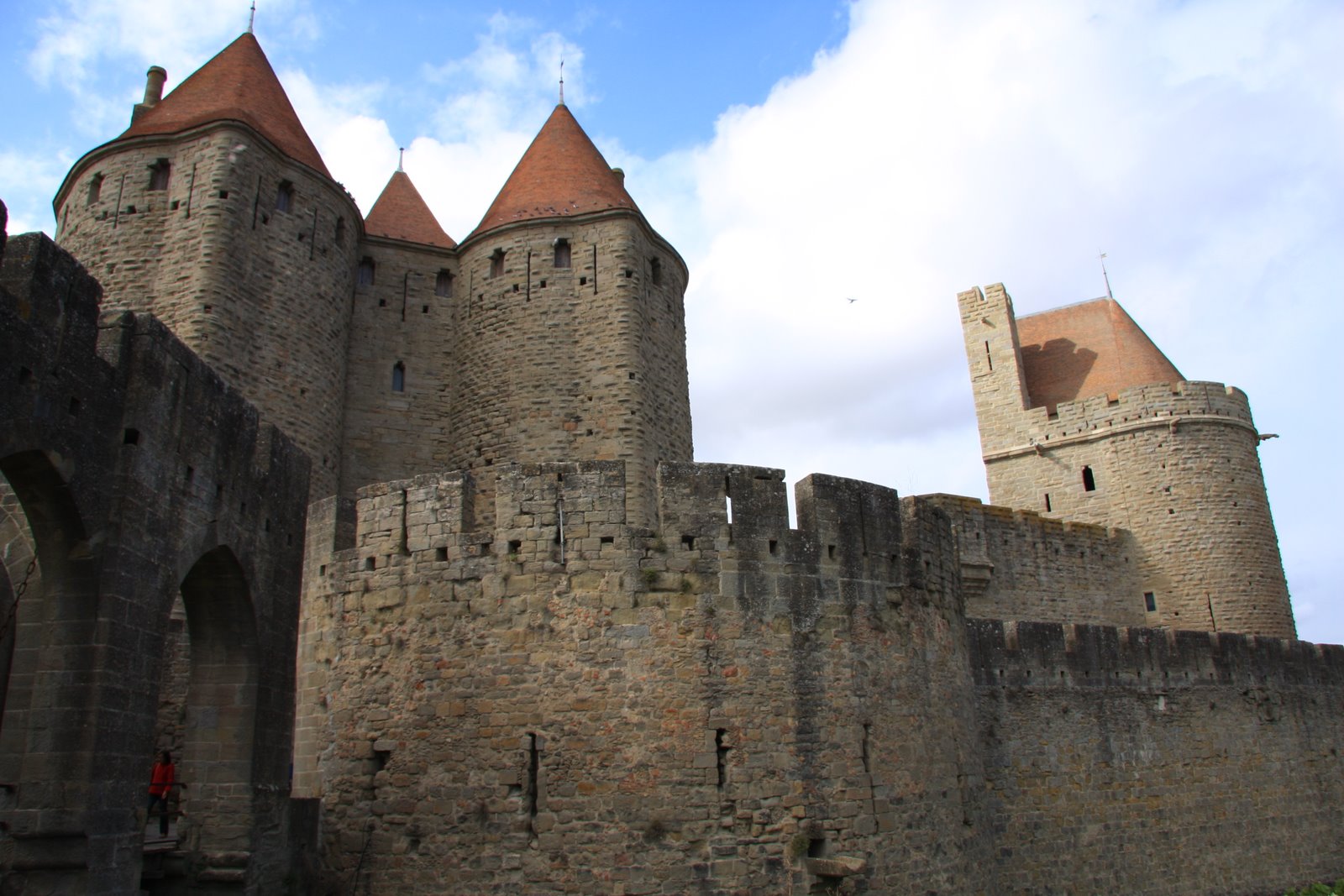
Discover Carcasonne *****


Carcassonne, designated a UNESCO World Heritage Site, is a beautifully restored fortified town, particularly famous as a Cathar stronghold during the Albigensian Crusades.

Visitors here cannot fail to be fascinated by the area's history. In the early 13th century the Catholic Pope launched a crusade against the Cathars. Languedoc was targeted as a Cathar stronghold and local people sought sanctuary in the impregnable hilltop fortresses where they endured many months of siege before succumbing. Many of the "heretics" were killed or burnt at the stake and the surrounding region was devastated. The proud ruins of many of these legendary fortresses, such as Quéribus and Peyrepertuse can be seen to this day, offering visitors an intriguing glimpse back in time as well as striking panoramic views of the surrounding countryside.

Carcasonne was lovingly restored in 1853 and today would not look out of place in a fairytale with its drawbridges and pointed towers. The town is actually divided into 2; the walled, medieval heart of the "Cité" and the commercial "Ville Basse" below. Most visitors head straight for the Cité and their first impressions are the splendid double ramparts surrounding the town, interspersed by 53 towers. Within the walls is the Château Comtal, built in the 12th century as home to the Trencavels, vicomtes of Carcassonne. Today there are guided tours and educational activities as well as a permanent exhibition about the restoration of the Cité.
Nearby, in the Place de l'église, is the Basilica of St-Nazaire. Described as "the jewel of the Cité" the cathedral was founded in the 11th century. Originally built in a Romanesque style, the gargoyles and more recent alterations give the building a more Gothic appearance.

A "petit train" regularly departs from the Porte Narbonnaise to give visitors a tour of the turrets and ramparts. And nearby, just outside the city walls is the Museum of the Middle Ages where visitors can enjoy a scale model of the city as well as interactive exhibits.
Source:ezinearticles

Thursday, April 22, 2010

Yann Tiersen *****

Guillaume Yann Tiersen (born June 23, 1970 in Brest, Brittany, France) is a French musician who is best known for being the composer of the soundtrack for the popular 2001 movie “Le Fabuleux Destin d’Amélie Poulain”. He has received classical training at several musical academies, including those in Rennes, Nantes, and Boulogne.

His music is mostly , decorated with piano, accordion, harpsicord, violin, mandolin, bass, guitar, banjo, melodica, toy piano, typewriter, vibraphone and various rhythm instruments. Yann Tiersen has also collaborated with vocal artists like Claire Pichet (“Le Phare” and “Rue Des Cascades”), Elizabeth Fraser (“Les Retrouvailles”) and Shannon Wright (“Yann Tiersen and Shannon Wright”). Other musicians he has worked with include The Divine Comedy, Noir Désir, dominique A., Francoiz Breut, Les Têtes Raides, The Married Monk and Sage Francis
Source:last.fm


Monday, April 19, 2010

Tapas *****

Tapas (IPA: [ˈtaˌpas]) is the name of a wide variety of appetizers, or snacks, in Spanish cuisine. They may be cold (such as mixed olives and cheese) or warm (such as chopitos, which are battered, fried baby squid). In North America and the United Kingdom, as well as in select bars in Spain, tapas has evolved into an entire, and sometimes sophisticated, cuisine. In these countries, patrons of tapas restaurants can order many different tapas and combine them to make a full meal.

The serving of tapas is designed to encourage conversation because people are not so focused upon eating an entire meal that is set before them.  Also, in some countries it is customary for diners to stand and move about while eating tapas.
Source:Wikipedia
 

Sunday, April 18, 2010

Strasbourg, Alsace, France *****


Strasbourg (pronounced: [stʁazbuʁ]; Alsatian: Strossburi, [ˈʃd̥rɔːsb̥uri]; German: Straßburg, [ˈʃtʁaːsbʊʁk]) is the capital and principal city of the Alsace region in north-eastern France. Located close to the border with Germany, it is the capital of the Bas-Rhin department. In 2006, the city proper had 272,975 inhabitants and its urban community 467,375 inhabitants. With 638,670 inhabitants in 2006, Strasbourg's metropolitan area ("aire urbaine") (only the part of the metropolitan area on French territory) is the ninth largest in France. The transnational Eurodistrict Strasbourg-Ortenau has a population of 884,988 inhabitants.[5]

Strasbourg is the seat of several European institutions such as the Council of Europe (with its European Court of Human Rights, its European Directorate for the Quality of Medicines and its European Audiovisual Observatory) and the Eurocorps as well as the European Parliament and the European Ombudsman of the European Union. Strasbourg is an important centre of manufacturing and engineering, as well as of road, rail, and river communications. The port of Strasbourg is the second largest on the Rhine after Duisburg, Germany.[6] The city is the seat of the Central Commission for Navigation on the Rhine.

Strasbourg's historic city centre, the Grande Île ("Grand Island"), was classified a World Heritage site by UNESCO in 1988, the first time such an honor was placed on an entire city centre. Strasbourg is fused into the Franco-German culture and although violently disputed throughout history, has been a bridge of unity between France and Germany for centuries, especially through the University of Strasbourg, currently the largest in France, and the co-existence of Catholic and Protestant culture.
Source: Wikipedia

Wednesday, April 14, 2010

Knokke, Belgium *****


Knokke (Dutch pronunciation: [ˈknɔkə]) is one of a group of communities that are all grouped in the administrative community Knokke-Heist, in the province of West Flanders in Flanders, Belgium. Knokke itself has 15,653 inhabitants (2003).

Knokke is the most North-Eastern seaside resort of the Belgian coast. It lies close to the Dutch border and is separated from the Dutch territory by the Zwin, a beautiful and extremely interesting natural reserve.  It is famous for its beaches, and for the dike system to which it owes its origins. 

Knokke came into existence because of the construction of dikes that were meant to protect the area around the 'Zwin' sea-arm. Originally a simple vacation haven for the city folk of Brussels in the early 1800s, artists such as James Ensor, Alfred Verwee and others, started to frequent the small hamlet to paint its beautiful vistas. The artists rented a small miller's cottage and founded the Cercle des Artistes in 1880. It gradually became a resort town with upscale clientele, restaurants and shops.

Knokke also has one of Belgium's ten casinos with art by Keith Haring, Rene Magritte and Paul Delvaux. The Kroonluchterzaal (Chandelier room) contains a 6 ton chandelier made of Venetian crystal. The chandelier has a diameter of 8.5 m and is 6.5 m high. Some 22,000 pieces of glass were used and 2,700 lamps light up the main hall. It was created by Architect J. Selis and designer Al. David.
Source: Wikipedia


Monday, April 12, 2010

Athens, Greece *****

Athens (pronounced /ˈæθɨnz/[2]; Greek: Αθήνα, Athina, IPA: [aˈθina]), the capital and largest city of Greece, dominates the Attica periphery; as one of the world's oldest cities, its recorded history spans around 3,400 years.

The Greek capital has a population of 745,514 (in 2001) within its administrative limits[1] and a land area of 39 km2 (15 sq mi).[3] The urban area of Athens extends beyond the administrative city limits with a population of 3,130,841 (in 2001)[1] and a land area of 412 km2 (159 sq mi).[3] According to Eurostat, the Athens Larger Urban Zone (LUZ) is the 8th most populous LUZ in the European Union (the 4th most populous capital city of the EU) with a population of 4,013,368 (in 2004).[4] A bustling and cosmopolitan metropolis, Athens is central to economic, financial, industrial, political and cultural life in Greece and it is rated as an alpha- world city.[5] It is rapidly becoming a leading business centre in the European Union. In 2008, Athens was ranked the world's 32nd richest city by purchasing power [6] and the 25th most expensive[7] in a UBS study.

Classical Athens was a powerful city-state. A centre for the arts, learning and philosophy, home of Plato's Academy and Aristotle's Lyceum,[8][9] It is widely referred to as the cradle of Western civilization and the birthplace of democracy,[10][11] largely due to the impact of its cultural and political achievements during the 5th and 4th centuries BC on the rest of the then known European continent.[12]

The heritage of the classical era is still evident in the city, represented by a number of ancient monuments and works of art, the most famous of all being the Parthenon, widely considered a key landmark of early Western civilization. The city also retains a vast variety of Roman and Byzantine monuments, as well as a smaller number of remaining Ottoman monuments projecting the city's long history across the centuries. Landmarks of the modern era are also present, dating back to 1830 (the establishment of the independent Greek state), and taking in the Hellenic Parliament (19th century) and the Athens Trilogy consisting of the National Library of Greece, the Athens University and the Academy of Athens. Athens was the host city of the first modern-day Olympic Games in 1896, and 108 years later it welcomed home the 2004 Summer Olympics.[13]
 Source: Wikipedia
***Hotel search in Athens by my fav. search engine ;)

Sunday, April 11, 2010

Crème brûlée *****


Crème brûlée (crème brulée in L'Orthographie 1990) (French for "burnt cream"; pronounced /ˌkrɛm bruːˈleɪ/ in English, [kʁɛm bʁyle] in French), burnt cream, crema catalana, or Trinity cream is a dessert consisting of a rich custard base topped with a contrasting layer of hard caramel. Although often served cold in North America, traditionally it is to be served warm.

The custard base is traditionally flavoured with vanilla, but is also sometimes flavored with lemon or orange (zest), rosemary, chocolate, coffee, liqueurs, fruits, and even spices such as ginger.
 Source: Wikipedia

Recommended kits:


Recommended recipe books:

Friday, April 9, 2010

Glacier Express, Switzerland *****


The Glacier Express is one of Switzerland's most famous train excursions. The Glacier Express, which has been operating since 1930, is billed as "the world's slowest express train" and averages 36 km/h (22 mph) during the approximately 7½-hour trip journey on its most popular route, Zermatt to St. Moritz or vice versa.
The 275 km miles (169 miles) of narrow-gauge track are punctuated by 291 bridges and 91 tunnels. Trains reach a peak elevation of 2,033 meters (6,670 feet) at the Oberalp Pass near Andermatt and traverse the 15-km (9.5-mile) Furka Tunnel, which takes a shortcut beneath the Alps between Andermatt and Brig.

The trains

Rolling stock varies from train to train. State-of-the-art "Glacier Express Premium" trains, which were introduced in 2006, have new panorama cars in First and Second Class (available for a higher surcharge). Other trains use conventional cars in First Class and panorama cars in Second Class.
Passengers on Glacier Express Premium trains can have meals served at seats or in the dining cars; on the standard trains, meals are served in the dining cars only, where angled-stem wineglasses help to prevent spilling during the steeper portions of the journey. All trains have Railbar carts that sell box lunches, salads, hot and cold drinks, etc.

Timetable and routes

The Glacier Express used to be a summer-only train, but today it operates year-round. The summer timetable offers four trains per day; the winter schedule is more limited. To make matters more complicated, not all Glacier Express trains go to St. Moritz. Some cover the Zermatt-Chur portion of the route, and you can also book a Glacier Express ticket between Zermatt and Davos via Chur. Consult the timetable at the Glacier Express Web site for details.

Travel tips

  • Some travelers feel that the south side of the train (the left side in the St. Moritz-Zermatt direction) offers better views, but both sides are fine.
  • If you dislike crowds (especially mobs of fellow tourists), skip the Glacier Express and take ordinary trains along the Glacier Express route. You won't get panoramic windows or an antique dining car, but you'll enjoy the same scenery--and you'll get a chance to stretch your legs by changing trains at several points along the way.
  • If you're on a tight budget, bring your own food. (At a few major stops, you'll have time to buy food from station vendors.)
  • First Class may be less crowded than Second Class, although that's not always true in high season. Comfort levels aren't vastly different, so don't feel that you have to pay extra for First Class.
  • Consider breaking your journey with an overnight stay in Chur. Seven or eight hours is a long time to sit on a train, and you may enjoy the scenery more when you spread it over two days.
 Source: europeforvisitors.com

Recommended hotels at Zermatt and St. Moritz.

Saturday, April 3, 2010

Santorini, Greece *****

Santorini (Greek: Σαντορίνη, pronounced [ˌsa(n)do̞ˈrini]) is a small, circular archipelago of volcanic islands located in the southern Aegean Sea, about 200 km (120 mi) southeast from Greece's mainland. The largest island is known as Thēra (or Thira, Greek Θήρα [ˈθira]), forming the southernmost member of the Cyclades group of islands, with an area of approximately 73 km2 (28 sq mi) and a 2001 census population of 13,670. It is composed of the Municipality of Thira (pop. 12,440) and the Community of Oía (Οία, pop. 1,230, which includes 268 inhabitants resident on the offshore island of Therasia, lying to the west). These have a total land area of 90.623 km2 (34.990 sq mi), which also includes the uninhabited islands of Nea Kameni, Palaia Kameni, Aspronisi, and Christiana (all part of the Municipality of Thira).

Santorini is essentially what remains of an enormous volcanic explosion, destroying the earliest settlements on what was formerly a single island, and leading to the creation of the current geological caldera.

A giant central lagoon, more or less rectangular, and measuring about 12 by 7 km (7.5 by 4.3 mi), is surrounded by 300 m (980 ft) high steep cliffs on three sides. The island slopes downward from the cliffs to the surrounding Aegean Sea. On the fourth side, the lagoon is separated from the sea by another much smaller island called Therasia; the lagoon merges with the sea in two places, in the northwest and southwest. The water in the centre of the lagoon is nearly 400 m (1,300 ft) deep, thus making it a safe harbour for all kinds of shipping. The island's harbours all lie in the lagoon and there are no ports on the outer perimeter of the island; the capital, Fira, clings to the top of the cliff looking down on the lagoon. The volcanic rocks present from the prior eruptions feature olivine and have a notably small presence of hornblende.[1]


It is the most active volcanic centre in the South Aegean Volcanic Arc, though what remains today is chiefly a water-filled caldera. The volcanic arc is approximately 500 km long and 20–40 km wide. The region first became volcanically active around 3–4 million years ago though volcanism on Thera began around 2 million years ago with the extrusion of dacitic lavas from vents around the region of Akrotiri.

The island is the site of one of the largest volcanic eruptions in recorded history: the Minoan eruption (sometimes called the Thera eruption), which occurred some 3,600 years ago at the height of the Minoan civilization. The eruption left a large caldera surrounded by volcanic ash deposits hundreds of feet deep and may have led indirectly to the collapse of the Minoan civilization on the island of Crete, 110 km (68 mi) to the south, through the creation of a gigantic tsunami. Another popular theory holds that the Thera eruption is the source of the legend of Atlantis.

The name Santorini was given to it by the Latin Empire in the thirteenth century, and is a reference to Saint Irene. Before then it was known as Kallístē (Καλλίστη, "the most beautiful one"), Strongýlē[citation needed] (Στρογγύλη, "the circular one"), or Thēra.
Source: Wikipedia

Holiday in Santorini:


Friday, April 2, 2010

Keukenhof, Lisse, The Netherlands *****

Keukenhof ("Kitchen garden", Dutch pronunciation: [ˈkøːkənˌhɔf]), also known as the Garden of Europe, is situated near Lisse, Netherlands, and is the world's largest flower garden. According to the official website for the Keukenhof Park, approximately 7,000,000 (seven million) flower bulbs are planted annually in the park.[1]

Keukenhof is located in South Holland in the small town of Lisse, south of Haarlem and southwest of Amsterdam. It is accessible by bus from the train stations of Haarlem, Leiden and Schiphol. It is located in an area called the "Dune and Bulb Region" (Duin- en Bollenstreek).

The garden was established in 1949 by the then-mayor of Lisse. The idea was to present a flower exhibit where growers from all over the Netherlands and Europe could show off their hybrids – and help the Netherlands export industry (it is the world's largest exporter of flowers). Keukenhof has been the world's largest flower garden for over fifty years.

Keukenhof is open annually from the last week in March to mid-May. The best time to view the tulips is around mid-April, depending on the weather. In 2010 Keukenhof will be open from March 18 to May 16.
Source: Wikipedia

Find hotels in Lisse or nearby cities (Amsterdam, Leiden, Haarlem....):

Beautiful tulips and friends:

Thursday, April 1, 2010

Lübeck, Schleswig-Holstein, Germany *****


The Hanseatic City of Lübeck (pronounced [ˈlyːbɛk]  ( listen), older [ˈlyːbeːk]) is the second largest city in Schleswig-Holstein, in northern Germany, and one of the major ports of Germany. It was for several centuries the "capital" of the Hanseatic League ("Queen of the Hanse") and because of its Brick Gothic architectural heritage is on UNESCO's list of World Heritage Sites. In 2005 it had a population of 213,983.

Situated at the Trave River, Lübeck is the largest German port on the Baltic Sea. The old part of the town is an island enclosed by the Trave. The Elbe-Lübeck Canal connects the Trave with the Elbe River. Another important river near the town centre is the Wakenitz. Autobahn 1 connects Lübeck with Hamburg and Denmark (Vogelfluglinie). The borough Travemünde is a sea resort and ferry port at the coast of the Baltic Sea.
Source: Wikipedia
Hotels in Lübeck:


Lübecker stuffs, yummies, recommended:

Tuesday, March 30, 2010

Eguisheim, Alsace, France *****

Eguisheim is a commune in the Haut-Rhin department in Alsace in north-eastern France. Eguisheim produces Alsace wine of high quality. The village centre is very picturesque and receives many tourists, as the Alsace "Wine Route" passes the village. The commune is largely German-speaking.
Source: Wikipedia

Hotels in Eguisheim:

Eguisheim in ...